
Kuna Previous Residents by Era
Start with the source closest to the date under study. The present parcel card anchors the land, while deeds move ownership backward. Reverse directories and census pages are stronger for occupants. Maps and city files help when an address changed or a building did not yet exist.
| Source | Years It Covers | Where Held | What It Shows |
|---|---|---|---|
| Ada Recorder index | 1982 to August 9, 2026 online | TylerWeb and Recorder | Parties, transfers, instruments, legal descriptions |
| Hill-Donnelly reverse directories | 1969-70, 1972-91, 1993-2004 | Boise Public Library | Address-to-name and phone-era evidence |
| Polk Boise/Ada directories | 1891-1945 irregular; later runs through 1968 | ISHS, Boise Library, UI, FamilySearch | Names, occupations, addresses, some household notes |
| Federal census | Relevant public releases through 1950 | National Archives and catalog services | Households, relationships, age, work, place labels |
| Kuna city archive | Minutes from 1915; ordinances from 1916 | City archive and ISHS transfer | Owners, officials, streets, subdivisions, hearings |
| Kuna Herald | 1914-1968 | ISHS microfilm | Obituaries, notices, weddings, civic and business clues |
| Sanborn map | December 1914 verified | Library of Congress | Footprint, lot, street, use, and construction clues |
A gap in one column is normal. Rural routes, city limits, directory publisher choices, and changed labels all affect coverage. Move sideways to another dated source before deciding the former household disappeared.
Trace Kuna Past Owners Backward
A backward title search begins with the Ada County parcel card, not a surname. Save the parcel number, situs and mailing addresses, subdivision, lot and block or legal brief, and current primary owner. The legal description keeps the trail together when the street label changes.
- Locate the latest deed or deed of trust in the Ada Recorder index. Match its parcel or legal description.
- Record the instrument number, date, parties, document type, and image status.
- Take the seller's name and search that person or entity as a grantee in an earlier deed.
- Repeat while the legal description remains continuous. Use a plat when a subdivision changes the description.
- For pre-1982 records, ask the Recorder, Idaho State Archives, or FamilySearch which book is indexed or imaged.
The Tyler index is a finding aid, not the instrument itself. Several document types are unavailable for online viewing. Request a narrow copy from the Recorder at 200 W. Front Street, Room 1207, Boise, by counter, phone, or email. Copies are $1 per page and certification is $1 per document.
Recorders cannot supply a ready-made history of a house. Give the office an instrument number and document type whenever the index provides them. For a pre-1982 gap, identify the likely grantor or grantee, approximate year, and legal description before contacting the Recorder or archive. Plats cost $11 for the first two pages and $5 for each added page; surveys cost $5 per page. Those documents can be worth the extra step when a later deed uses a new lot and block description that does not match the older land wording.
Kuna Address History Terms
These terms prevent role and place errors in a search for previous residents.
- Grantor
- The party giving or transferring an interest in a recorded instrument.
- Grantee
- The party receiving that interest.
- Chain of title
- The linked sequence of recorded transfers for the same land.
- Legal description
- The lot, block, survey, or other land wording that identifies the parcel more reliably than an old street label.
- Criss-cross directory
- A directory arranged by address rather than only by surname.
- Enumeration place
- The census area label used when the count was taken, which may not match today's city line.
Ownership and occupancy are not synonyms. A deed can name an owner without naming every person who lived there, while a directory may list an occupant who never held title.
Kuna Previous Residents in TylerWeb
The live Recorder search accepts both names, date ranges, instrument number, book and page, grantor, grantee, parcel, Public Land Survey fields, and document type. Search spelling variants. A result can expose the recording timestamp, page count, party roles, and document description even when the image says it is unavailable.
This matters for past residents because an index hit should guide the copy request, not replace it. An affidavit in lieu of probate, order determining heirs, deed, reconveyance, lien, plat, or power of attorney can explain why a name enters or leaves the property trail. Read the actual instrument before asserting the relationship.
Reverse Search Past Kuna Residents
Boise Public Library's Hill-Donnelly runs cover 1969-70, 1972-91, and 1993-2004. Search the address first, then test the surname elsewhere in the book. A missing year is a collection gap, not proof that the home stood empty.
The University of Idaho guide carries an important local quirk: “Kuna, see Boise” and “see also Nampa.” The University directory holdings page captured for this project shows that regional route.
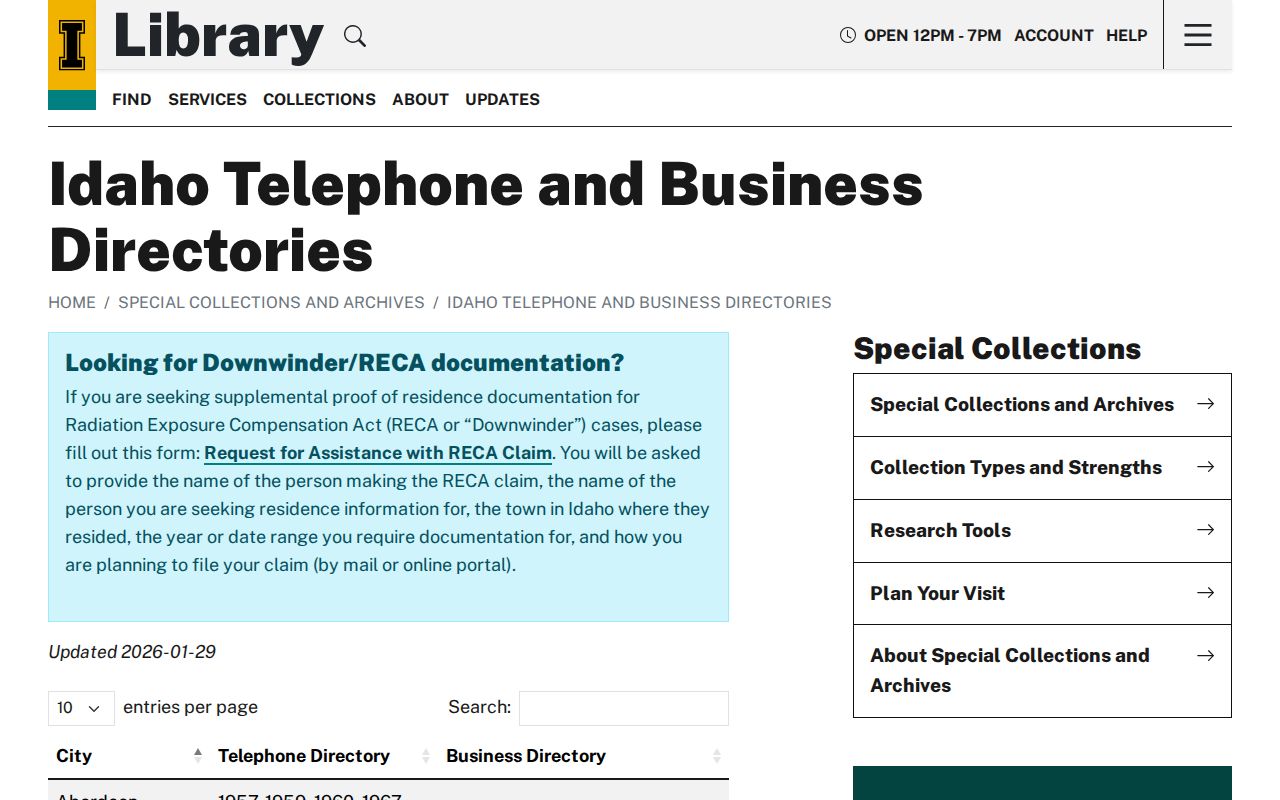
Search Boise, Nampa, Ada County landowner sections, and regional supplements before treating the lack of a stand-alone Kuna volume as a dead end.
A digitized Polk volume offers another way to inspect the publisher's structure. The digitized Boise directory is shown in the next capture.
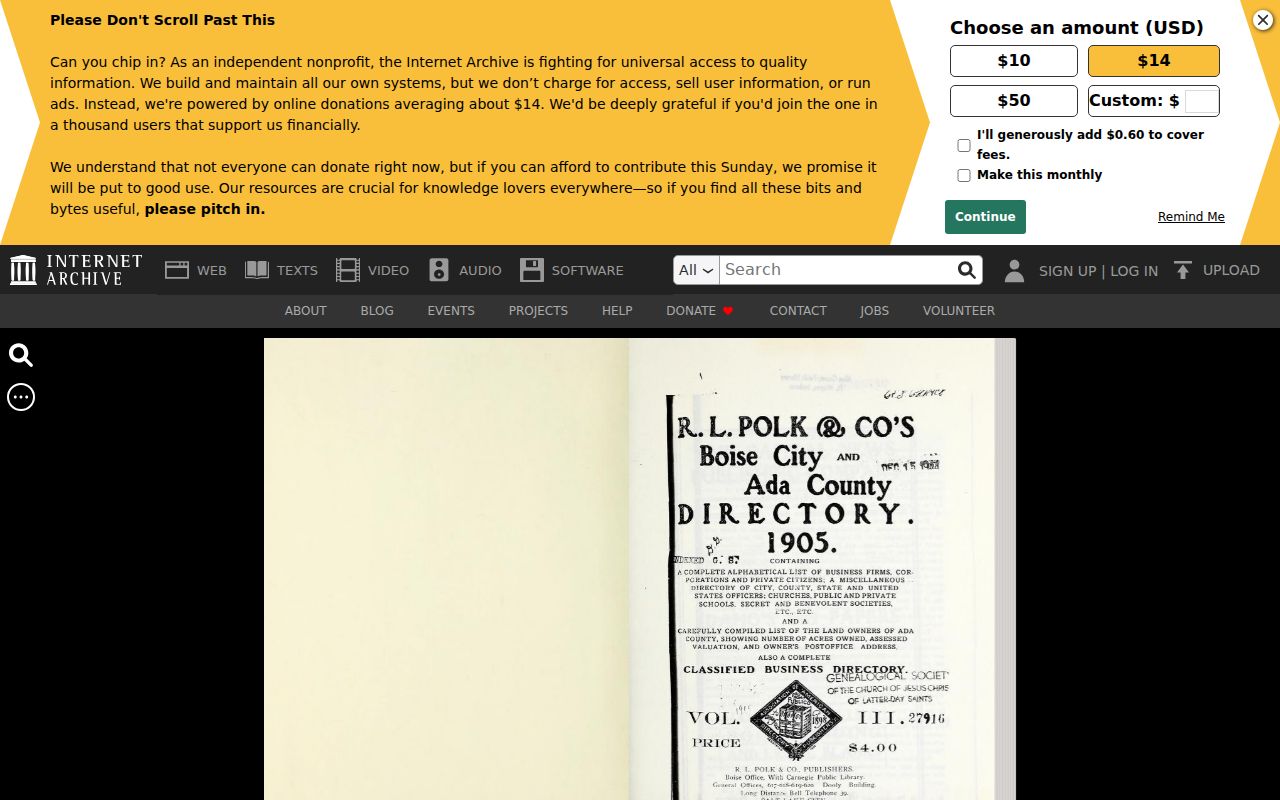
Use its contents, regional pages, surname sequence, and address references as finding tools. Do not invent a Kuna entry that the scanned page does not show.
Pair Kuna Directories and Census
Once an address and likely era are fixed, pair a nearby directory year with the public federal census. The directory gives annual or near-annual commercial evidence. Census schedules can name household members, relationships, ages, and work, but use the enumeration place and boundary from that census year.
- Search the reverse directory by the known address and record the line exactly.
- Check the surname index, initials, “widow of” notation, and nearby street spellings.
- Open the closest public census year and verify the place, street, house number, and household.
- Add a dated newspaper notice or deed to separate two people with the same name.
- If the entry vanishes, test Boise, Nampa, rural routes, and new street labels.
The full collection history belongs on the Kuna city directories page. Here, each volume serves one backward step for one property.
Use the census with care. The 1900 schedule may cover the area before Kuna incorporated in 1915, and later place lines may not match today's municipal boundary. Public federal schedules for 1910, 1920, 1930, 1940, and 1950 can support the address trail when the enumeration area fits. The 1950 census became public in 2022 under the 72-year release rule. A person found in a regional directory should therefore be checked against the census place and township rather than silently assigned to modern Kuna.
Map a 1914 Kuna Address
The Library of Congress has a free December 1914 Kuna Sanborn sheet. It can establish a building footprint, lot line, street width, material, story count, use, and nearby water feature. It does not identify every person in the building. A 1931 item pattern needs verification before use.
Compare the 1914 footprint with the current parcel and a directory or newspaper from a close year. If the lot shape no longer aligns, use the recorded plat and Ada County corner records. No official Kuna-wide renumbering year was found, so search both historical and current labels.
Kuna Residents Beyond Online Indexes
The Kuna Historical Society and Arts and History Center preserve photographs, artifacts, family stories, and exhibit context. Their manifest capture shows the local starting point for a focused question.
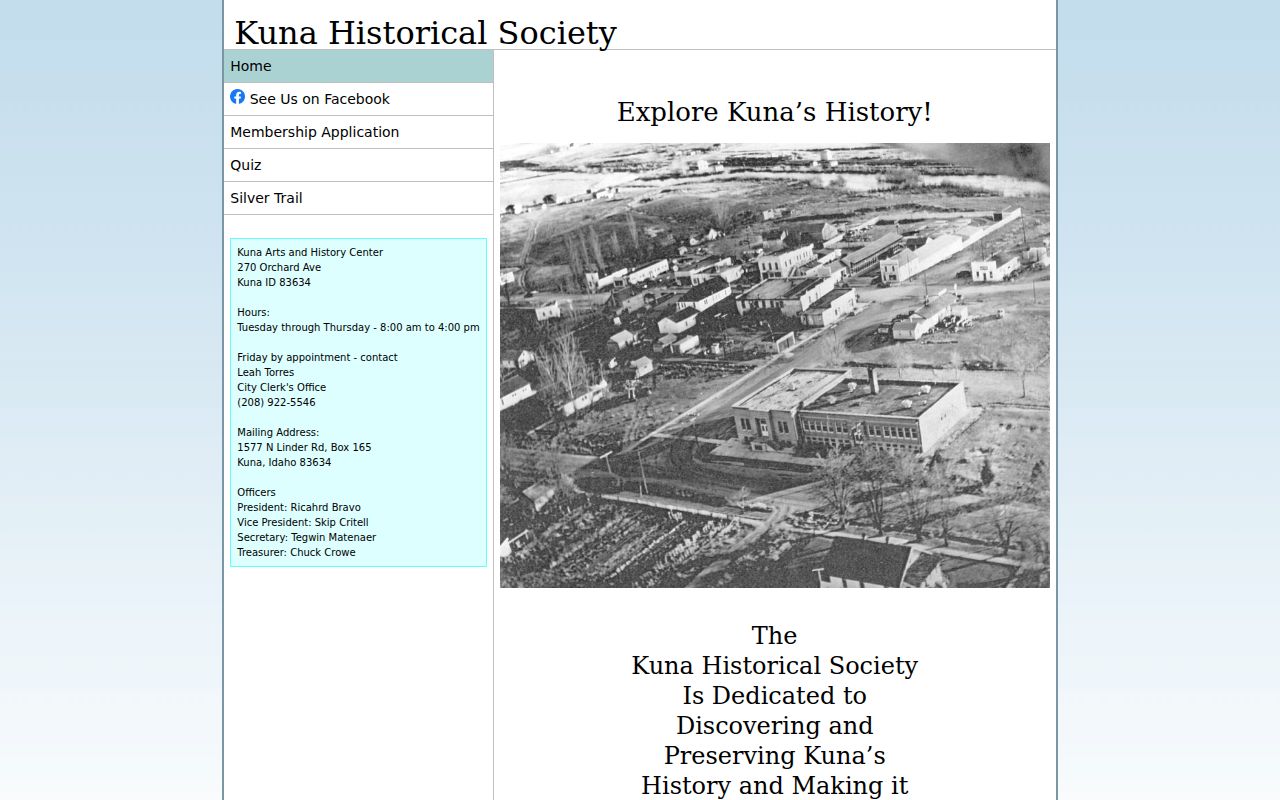
Ask about one street, family, railroad route, irrigation project, or photo rather than requesting a modern people list. The center is at 270 Orchard Avenue, with Tuesday through Thursday hours of 8 to 4 and Friday visits by appointment.
For statewide name bridges, the Idaho Historical Society searchable indexes include the Idaho Biographical Index and a reconstructed 1890 census built from varied records.
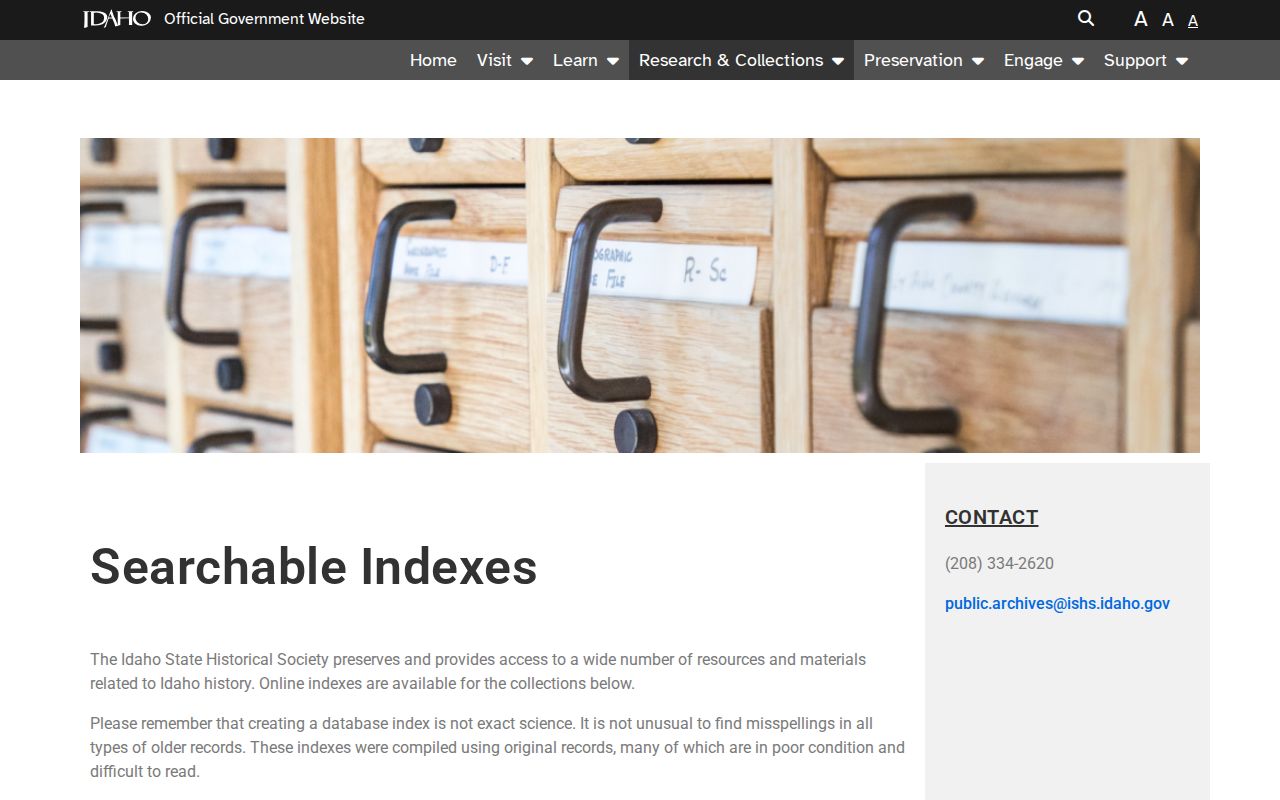
Those indexes can point to a source, but the cited source still controls the date, identity, and relationship.
Kuna Past Residents in Newspapers
Kuna Herald microfilm spans November 19, 1914, through September 27, 1968. Obituaries, weddings, legal notices, civic reports, and business items can explain a household's arrival or departure. Boise Public Library also offers clipping files, newspaper tools, obituary resources, and focused directory-copy research.
The Boise local-history service appears in the project capture.
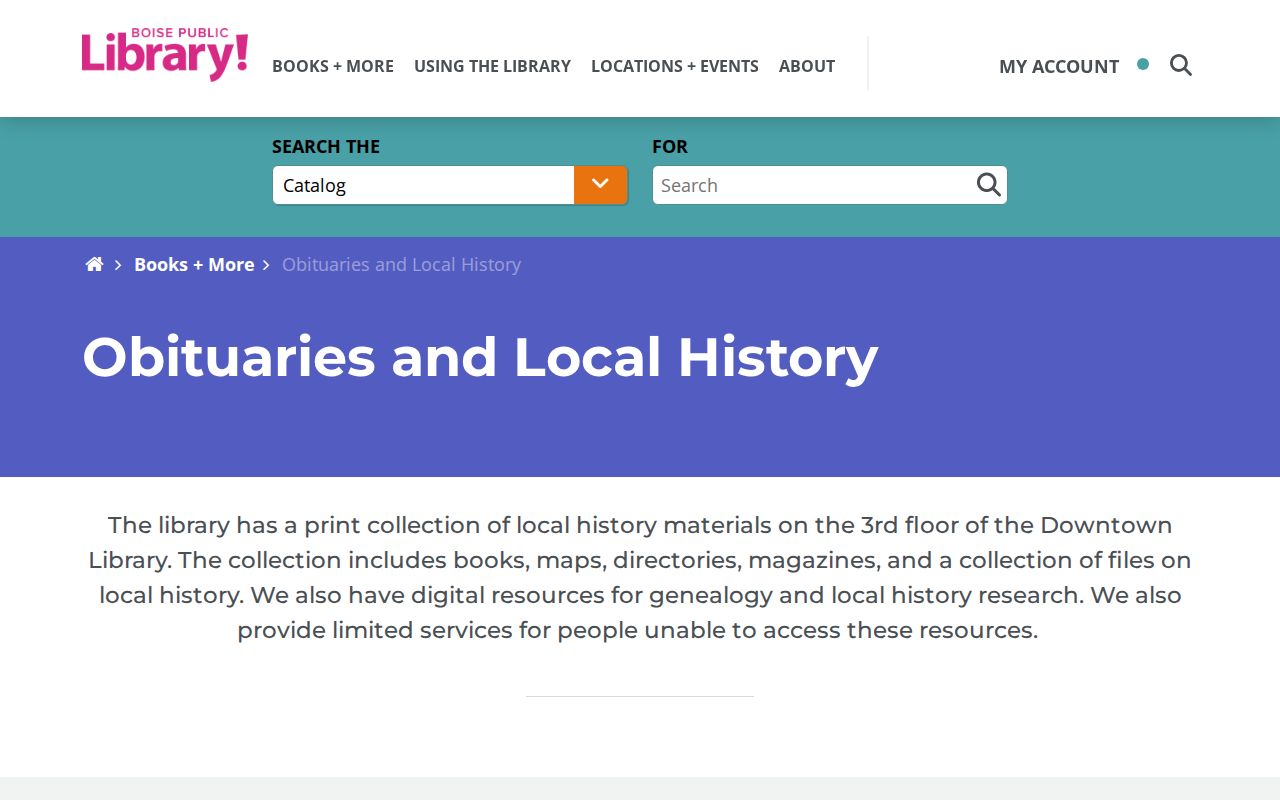
Give staff a name, address variant, and narrow year range. Then connect the item to a deed, probate file, affidavit, or directory rather than relying on the newspaper alone.
Probate and recorded heir documents are especially useful at the end of a household trail. When a directory name disappears, an obituary may identify relatives or a death date. An Ada County probate file, order determining heirs, or affidavit in lieu of probate may then explain the next recorded transfer. Keep restricted court and vital material out of the search unless the official eligibility rules allow access. A family link should come from the record itself, not from the fact that two surnames appear near the same Kuna address.
Limits on Kuna Previous Residents
Directory absence is not proof of absence. Rural residents, people listed under a spouse's name, new subdivisions, missing annual runs, and books organized through Boise can all create gaps. Sanborn maps show structures, not complete households. Assessor cards show tax ownership, not every occupant. Census data uses its own historic geography.
City archives split as well. Kuna's online files begin with 1915 minutes and 1916 ordinances. Resolution R49-2017 transferred permanent municipal records from 1915 through 2016 to the Idaho State Historical Society, so a request may need both custodians. Building permits have no verified public Kuna index and require a narrow city request.
Lawful use. Research previous residents for house history, family history, heirs, or personal study. Never use an address trail to harass, track, threaten, or harm a living person.